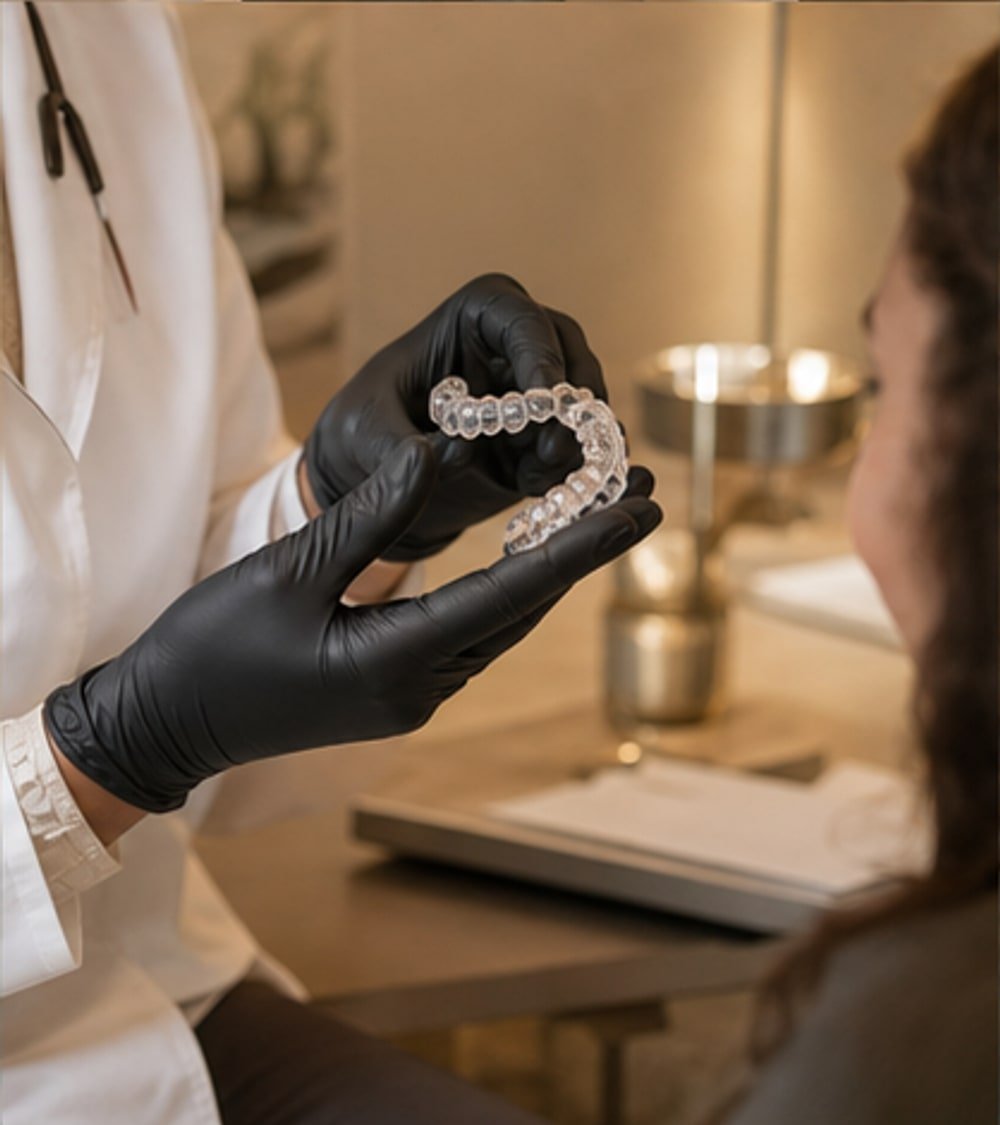
01 / NEED AND POSSIBILITIESHow do clear orthodontic aligners work?
Orthodontic overlays, also known as aligners, are thin, removable appliances custom-made for the patient. Treatment consists of a series of sets. Each set achieves a small portion of the planned tooth movement, and the entire series guides the teeth step-by-step toward the established goal.
Transparent orthodontic aligners are a discreet method of moving teeth using successive, individually planned sets. However, they are not a universal solution or a therapy conducted solely by software. The orthodontist is responsible for diagnosis, planning movements, biological control and modifying treatment when the situation requires it. Qualification for aligners in our office in Chorzów, near Katowice, takes into account the type of malocclusion, the condition of the teeth and periodontium, and the readiness for systematic wearing. The patient learns about the course, hygiene rules, the role of attachments, possible refinements and the need for retention after the end of therapy.
Digital visualization helps in discussing the treatment plan, but it does not provide treatment on its own and offers no guarantee of the final result. The orthodontist is responsible for diagnosis, biomechanics, tissue safety, and decisions made during therapy. Therefore, we do not begin by asking "which system should I choose?", but rather by determining what the bite requires and whether clear aligners are the right tool.
02 / CONSULTATION AND DIAGNOSISFor whom might dental aligners be suitable?
Aligners can be used to treat a wide range of irregularities; however, crowding that appears similar may require a completely different scope of tooth movement. Patient assessment involves examining the bite, teeth, gums, jaw relationships, and functional aspects, as well as analyzing the necessary documentation.
01 / Teeth alignment
Crowding, spacing, relapse after previous treatment, and other issues, provided the planned movements can be safely achieved with aligners.
02 / Occlusion and function
Selected malocclusions requiring coordination of both arches, sometimes involving the use of attachments, elastics, or other elements.
03 / Day-to-day cooperation
The patient is willing to wear the aligners for the majority of the day, change them according to the schedule, and report any fit issues.
04 / Zdrowa jama ustna
Treated cavities, stable gums, and a level of hygiene that allows for safe orthodontic treatment.
In more complex situations, the plan may require additional components, a combination of methods, or a fixed appliance. An honest assessment also includes the answer "aligners are not the best choice right now." Read,What a comprehensive orthodontic consultation looks like.
03 / INFORMED CHOICE OF METHODOrthodontic aligners or fixed braces?
There is no single method that is best for everyone. Fixed braces and aligners can achieve similar results, but they differ in how they work, their requirements, and the level of control over specific tooth movements. The orthodontist should compare the options available for the specific malocclusion, while the patient should assess which responsibilities they can realistically fulfill.
01 / Dyskrecja
The aligners are transparent but not completely invisible. Attachments and elastics may be noticeable up close.
02 / Zdejmowanie
They can be removed for eating and hygiene. This freedom also entails the responsibility to wear them regularly.
03 / Treatment monitoring
Fixed braces work continuously; aligners work only when worn. For certain types of tooth movement, one method may be more predictable than the other.
04 / Everyday Life
Aligners make cleaning teeth easier and do not impose the same dietary restrictions as brackets, but they do require planning meals and managing storage.
A detailed breakdown can be found in the guide:Fixed braces or aligners - what is worth knowing before choosing. You can also get to knowtreatment with fixed appliances.
04 / INDYWIDUALNY PLANHow does treatment with clear aligners work?
01 / Consultation and diagnostics
comprehensive diagnostics and orthodontic assessment
02 / Digital treatment plan
digital plan of subsequent tooth movements
03 / Wearing subsequent aligners
custom set of aligners and necessary additional components
04 / Kontrole i retencja
treatment progress checks, plan adjustments, and subsequent retention
Following diagnostics, a digital tooth movement plan is created. Depending on clinical indications, attachments may be bonded to certain teeth, and the treatment may involve elastics or other components. The patient receives a series of aligners and a schedule for changing them, though the pace is always dictated by the biological response of the tissues and clinical monitoring.
Before starting, we discuss the goal, alternatives, patient responsibilities, and the estimated timeframe and costs. Only then is an informed decision about treatment made, with no obligation to choose aligners during the initial consultation.
05 / DAILY LIFE WITH ALIGNERSWearing, eating, and hygiene of orthodontic aligners
The ability to remove aligners is a practical advantage, but it also entails a crucial requirement for patient cooperation. An aligner left in its case for hours does not perform the work it was designed to do. Therefore, before starting treatment, it is worth honestly assessing your daily routine, the number of meals you eat, and your readiness to maintain a regular oral hygiene regimen.
01 / Noszenie
The aligners remain on the teeth for the duration recommended by the orthodontist—usually for the majority of the day. Short, regular breaks are taken for meals and oral hygiene.
02 / Jedzenie i picie
Aligners are removed for eating. It is safest to drink cool water while wearing the trays to minimize deformation, discoloration, and sugar contact with the teeth.
03 / Higiena
Clean your teeth before putting the aligners back in, and care for the aligners according to the instructions. Dental check-ups are still required.
04 / Przechowywanie
After removal, the aligner goes into the case, not into a tissue or your pocket. It is worth keeping the previous set in case the doctor decides to temporarily switch back to it.
Why are orthodontic check-ups necessary?
During appointments, we check whether the teeth are moving according to plan, the aligners fit properly, the attachments are intact, and the teeth and gums remain healthy. We do not evaluate only whether the smile looks better; the check-up also covers the bite, tooth contacts, and tissue health.
The digital treatment plan may require adjustment. An additional scan and a subsequent series of aligners—sometimes referred to as "refinement"—do not necessarily indicate an error; they may represent a responsible response to the actual progress of treatment. Skipping check-ups, wearing the aligners for insufficient time, or moving on to the next sets without approval can compromise the fit and prolong the course of treatment.
07 / HEALTH BEFORE AESTHETICSWhat needs to be checked before clear aligner treatment?
Tooth decay, active gum inflammation, and inadequate oral hygiene require prior treatment or stabilization. Orto Smile does not provide general restorative dentistry; therefore, we refer patients to a dentist when necessary. Regular dental check-ups are also required during orthodontic treatment.
You should inform your doctor about any medical conditions, medications you are taking, periodontal issues, dental injuries, and previous treatments. The aligners are medical devices manufactured according to a treatment plan; purchasing a kit without a comprehensive examination and subsequent supervision is not a substitute for orthodontic treatment.
08 / UTRZYMANIE EFEKTURetention after orthodontic aligner treatment
Treatment does not end with the final aligner. After active tooth movement, a retainer is required to help stabilize the teeth's position. The type of retention, wear schedule, and follow-up appointments are determined by the orthodontist based on the course of treatment and the patient's bite.
Teeth can shift position even later on, so it is not worth waiting until your next scheduled appointment to deal with a damaged, lost, or ill-fitting retainer. We explain more in the article.retention after orthodontic braces - how to maintain the treatment effect.