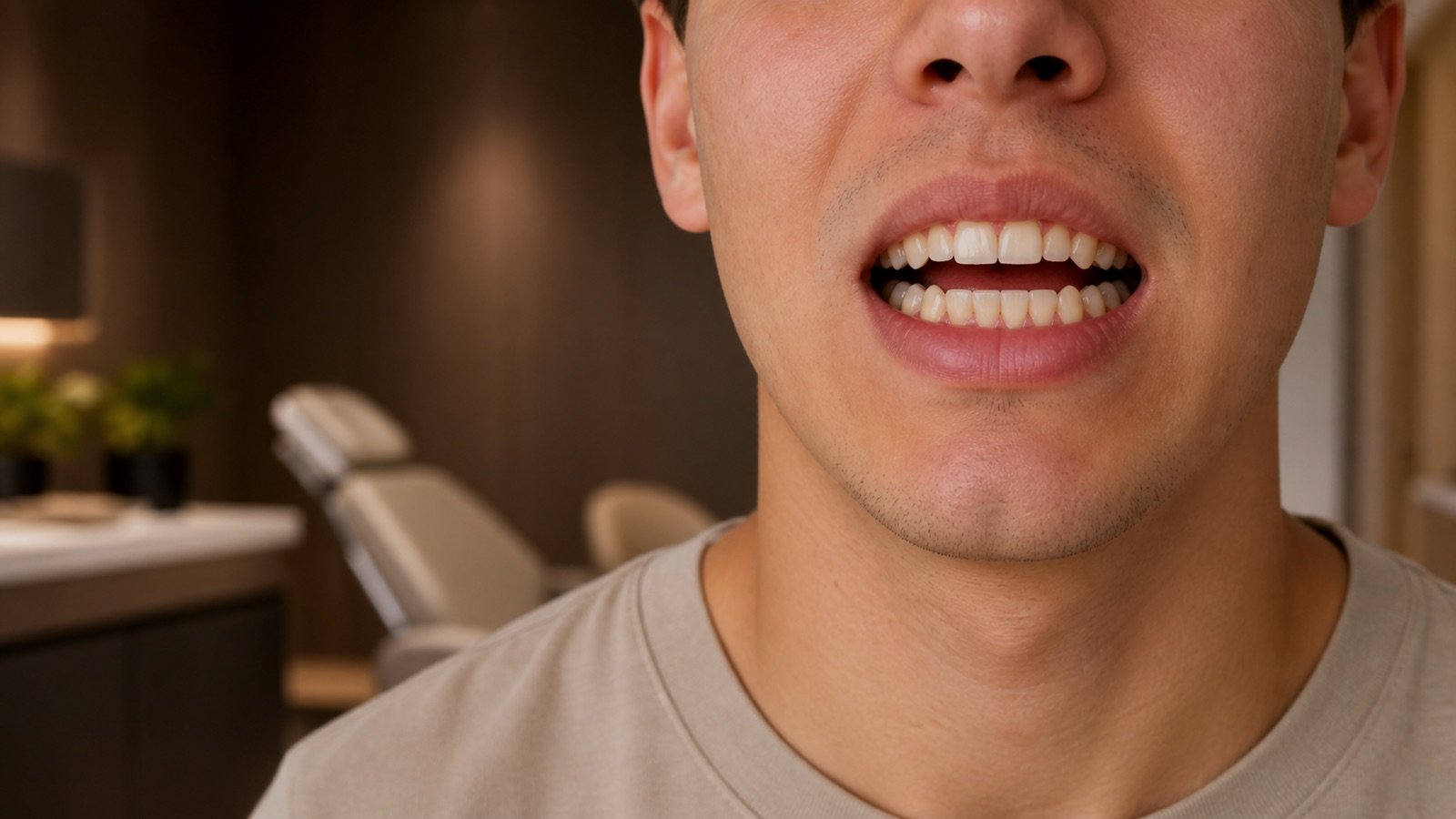
01 / INTRODUCTIONOpen bite – what is worth knowing?
An open bite occurs when some of the upper and lower teeth do not come into contact with each other. The space may concern the anterior or lateral segment.
Orthodontic evaluation does not end with naming the malocclusion. The same visible problem may have different causes in a growing child, a teenager and an adult. Therefore, the plan covers tooth alignment, jaw relationship, function, periodontal health, and the impact of treatment on the profile and smile.
An open bite means that certain teeth do not come into contact despite the remaining part of the arches being closed. Most often, patients notice a space between the incisors, problems with biting food, abnormal tongue function or a characteristic way of swallowing and speaking. The malocclusion may have a dental, functional or skeletal basis, so simply moving the teeth is not always enough. Treatment of an open bite requires an assessment of habits, tongue function, jaw growth, and the stability of the planned result. We offer patients from Katowice and Chorzów a plan based on full diagnostics and, if necessary, coordinated cooperation with a speech therapist, laryngologist or surgeon.
02 / SIGNALSWhat might attract attention?
- no contact of the incisors when biting
- difficulty biting selected foods
- inserting the tongue between the dental arches
- characteristic pronunciation or compensatory way of swallowing
The list helps you recognize the signals, but is not intended for self-diagnosis. Some problems are only visible during a bite examination or an X-ray.
03 / SUBSTRATEWhy might the problem occur?
- the way the jaws grow and the vertical proportions of the face
- sucking habits and long-term pacifier use
- incorrect position and operation of the tongue
- airway patency disorders requiring separate assessment
Most often, several factors act at the same time. Recognizing the cause helps assess the stability of the planned effect and the possible need for cooperation with other specialists.
04 / DIAGNOSTICSWhat does the orthodontist analyze?
The visit begins with a conversation about health, previous treatment and expectations. The face, profile, smile, tooth alignment, occlusal contacts and function are then assessed. The scope of photographs, scans and radiological tests is selected individually.
Teeth relationship
Location of crowns and roots, amount of space and contacts between arches.
Jaw relationship
Proportions, symmetry and possible contribution of growth to the malocclusion.
Biological conditions
The condition of enamel, gums, bones and other structures important for safety.
What might a treatment plan look like?
- determining whether the problem has a dental, functional or skeletal advantage
- assessment of habits, tongue position and breathing conditions
- control of the vertical position of the teeth and the relationship of the jaws
- If necessary, cooperation with a speech therapist, laryngologist or surgeon
Fixed braces, aligners, removable braces or team treatment are not an end in themselves. These are tools selected for recognition. The final scope, time, costs and possible alternatives can only be determined once the diagnostics are completed.
06 / THE MOMENT OF TREATMENTWhen is it worth coming for a consultation?
Early elimination of the habit may change the direction of the problem, but it does not replace diagnosis. In adults with severe skeletal disease, the options for orthodontics alone may be limited.
It is also worth making an appointment if the change progresses, makes hygiene or biting difficult, causes tissue injuries or raises concerns about the development of the child's bite.
ImportantThe content is educational in nature and does not replace an individual examination or medical diagnosis.