Braces and aligners · patient guide
Fixed braces or clear aligners — what should you know before choosing?
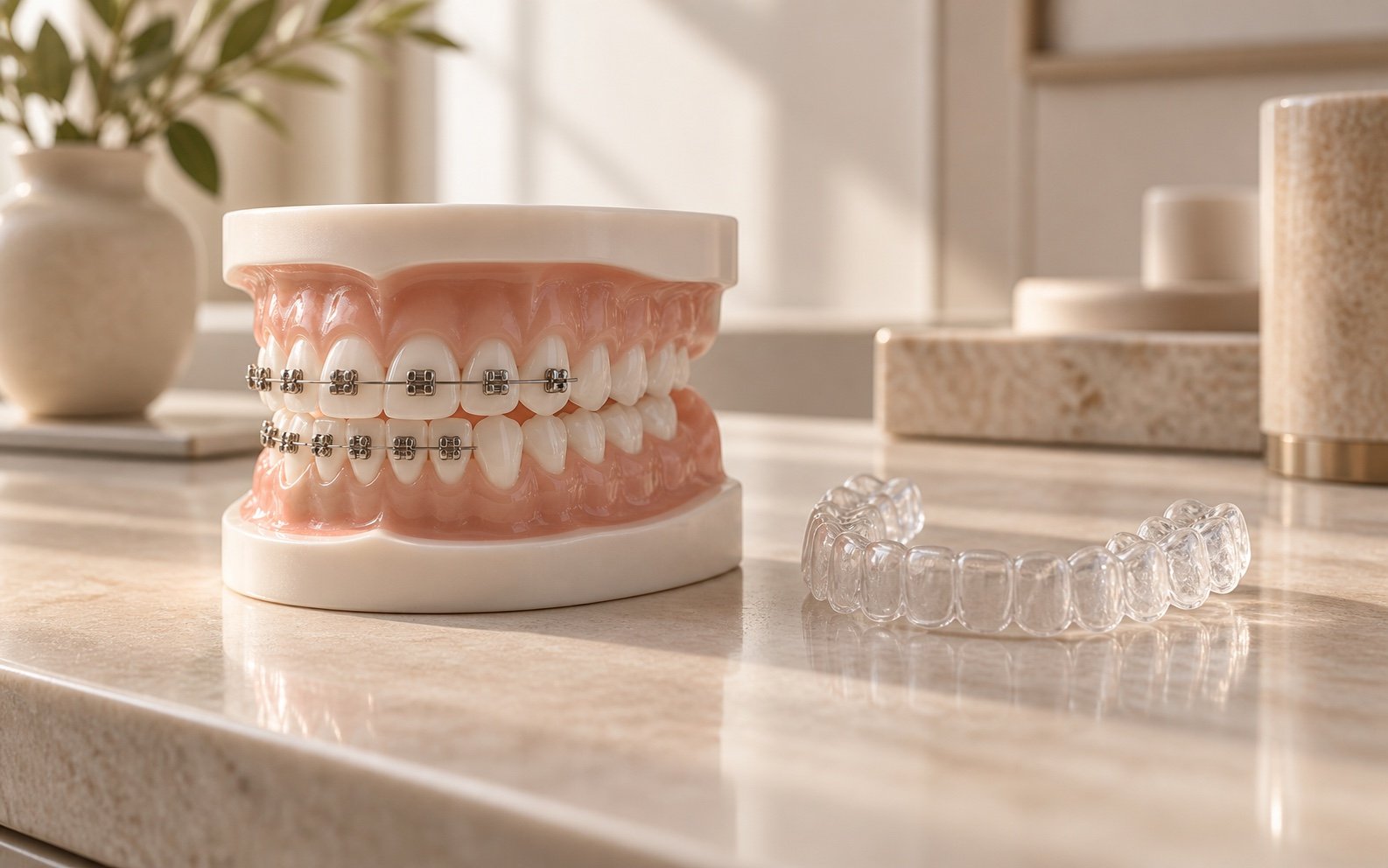
Fixed braces and clear aligners can both move teeth effectively, but they differ in how they work, when they are suitable and what they require from the patient. A sound choice begins with examination, diagnostics and an individual treatment plan — not with appearance or price alone.
 ortosmilesilesia.pl
Fixed braces or aligners? The short answer
The right option depends on the type and severity of the bite problem, oral and periodontal health, planned tooth movements, age and the patient’s ability to follow instructions.
Clear aligners can be an effective alternative in selected mild-to-moderate problems. Fixed appliances may offer greater predictability for some complex movements. Current reviews also note limitations in the quality of evidence, so treatment should not be chosen from advertising or another patient’s experience alone.
How do fixed braces work?
Brackets are bonded to the teeth and connected by an orthodontic wire. The system applies planned forces that gradually change tooth position. Because the appliance stays in place, its action does not depend on remembering to wear it.
Elastics, springs and different wires may be used according to the treatment plan. Review visits monitor progress, hygiene and the tissues’ response.
Main advantages
- continuous action
- broad control of many complex tooth movements
- no risk of losing the entire appliance
- wide choice of auxiliary components
Important responsibilities
- careful cleaning around brackets and under the wire
- avoiding hard or sticky foods that can damage the appliance
- accepting visibility and possible short-term soreness
- contacting the practice promptly if a component breaks
How do clear aligners work?
Aligners are a sequence of custom-made clear trays. Each tray performs part of the planned movement and is changed according to the prescribed schedule. Small tooth-coloured attachments may be needed to improve control.
They are removed for meals, drinks other than water and oral hygiene. Their effectiveness relies on wearing them for the time prescribed in the individual plan.
Main advantages
- discreet appearance
- removal for meals and brushing
- easy access to tooth surfaces during cleaning
- no brackets or protruding wire ends
Important responsibilities
- consistent wear
- cleaning teeth before reinsertion
- safe storage in a case
- accepting possible attachments, elastics and refinement stages
Fixed braces vs aligners — key differences
| Factor | Fixed braces | Clear aligners |
|---|---|---|
| Visibility | Brackets and wire are visible; less conspicuous variants may be available. | Discreet but not invisible; attachments may be visible. |
| Compliance | Works continuously, although elastics and appointments still matter. | Requires consistent wear and correct tray changes. |
| Eating | Foods that may damage brackets or wires should be avoided. | Removed for meals; teeth should be cleaned before reinsertion. |
| Hygiene | Needs careful cleaning around components. | Teeth are cleaned without the appliance; trays also need cleaning. |
| Comfort | Temporary soreness and rubbing may occur. | Pressure, temporary speech change or edge irritation may occur. |
| Treatment range | Very broad, including many complex situations. | Broad, but predictability depends on the movement and patient cooperation. |
| Retention | Required after treatment. | Also required after treatment. |
What determines suitability?
The clinician assesses the bite, tooth position, gums, hygiene, radiographs and photographs. Bone conditions, jaw joints and other planned dental care may also matter.
Planning considers:
- type and severity of malocclusion
- need for extractions or space creation
- root control and relationships between the arches
- enamel, gum and periodontal health
- attendance and ability to follow instructions
- aesthetic expectations, lifestyle and budget
Sometimes both methods are reasonable. Sometimes one offers better control. A hybrid plan may also combine different tools at different stages.
Oral hygiene during treatment
Teeth and gums should be healthy before treatment. Appliances do not cause decay by themselves, but they can create additional plaque-retentive areas.
Fixed braces require careful cleaning around brackets, the gumline and under the wire. Aligners make the teeth easier to reach, but replacing a tray over unclean teeth can hold food and sugars against enamel.
Regular dental check-ups remain important with either method. The orthodontist manages tooth movement, while preventing decay and gum disease remains a shared responsibility of the patient, orthodontist, dentist and dental hygienist.
Are aligners faster than fixed braces?
There is no universal answer. Duration depends on the problem, planned movements, biological response, additional procedures and cooperation. Technology alone does not guarantee shorter treatment.
Some studies report shorter aligner treatment in selected simpler cases, but this cannot be applied to every malocclusion. Complex cases may need refinement trays or a revised plan.
What determines the cost?
The cost includes diagnostics, planning, the appliance or aligner system, reviews, possible auxiliaries, finishing and retention. With aligners, the number of planned stages and the scope of the package may matter; with fixed braces, the bracket system and treatment course can affect the total.
When comparing fees, ask exactly what is included: records, review visits, emergencies, refinement trays, appliance removal and retainers. Current Orto Smile prices are listed in the price guide, while an individual estimate is prepared after diagnostics.
Retention is needed after both methods
After active tooth movement, retention begins. The tissues need time to adapt, and teeth retain a natural tendency to move. Fixed, removable or combined retainers may therefore be prescribed after both braces and aligners.
The clinician determines the retainer type and wear schedule. Report a lost, cracked or detached retainer promptly, because delay may allow teeth to change position.
How the decision is made
Only then does the comparison relate to you rather than to a generic list of advantages.
- 1
Conversation and examination
We discuss health, previous treatment, needs and daily routine.
- 2
Diagnostic records
Photographs, a dental scan and indicated radiographs are obtained.
- 3
Analysis and plan
The clinician explains goals, suitable methods, limitations and monitoring.
- 4
Informed decision
You receive clear information about use, duration, costs and retention.
Frequently asked questions
Are aligners as effective as braces?
Both can work well in selected cases. Effectiveness depends on the movement, the plan and cooperation; fixed braces may be more predictable for some complex problems.
Can everyone choose aligners?
No. Bite, oral health and the ability to wear them consistently must be assessed first.
How many hours should aligners be worn?
The clinician specifies this for the chosen system and plan. They are generally intended for most of the day and removed mainly for meals and hygiene.
Do fixed braces hurt more?
Both methods can cause temporary tenderness. Individual experiences vary.
Are aligners invisible?
They are discreet, not invisible. Attachments and elastics may also be needed.
Which is easier to clean?
Aligners can be removed for brushing, but teeth and trays both need careful cleaning. Fixed braces require extra attention around brackets and wires.
Is a retainer required?
Yes, after both fixed braces and aligners.
Must I choose before my consultation?
No. Suitable options can be discussed properly after examination and diagnostics.