Orthodontics · fixed braces · comparison
Fixed braces: metal, ceramic or self-ligating — which to choose?
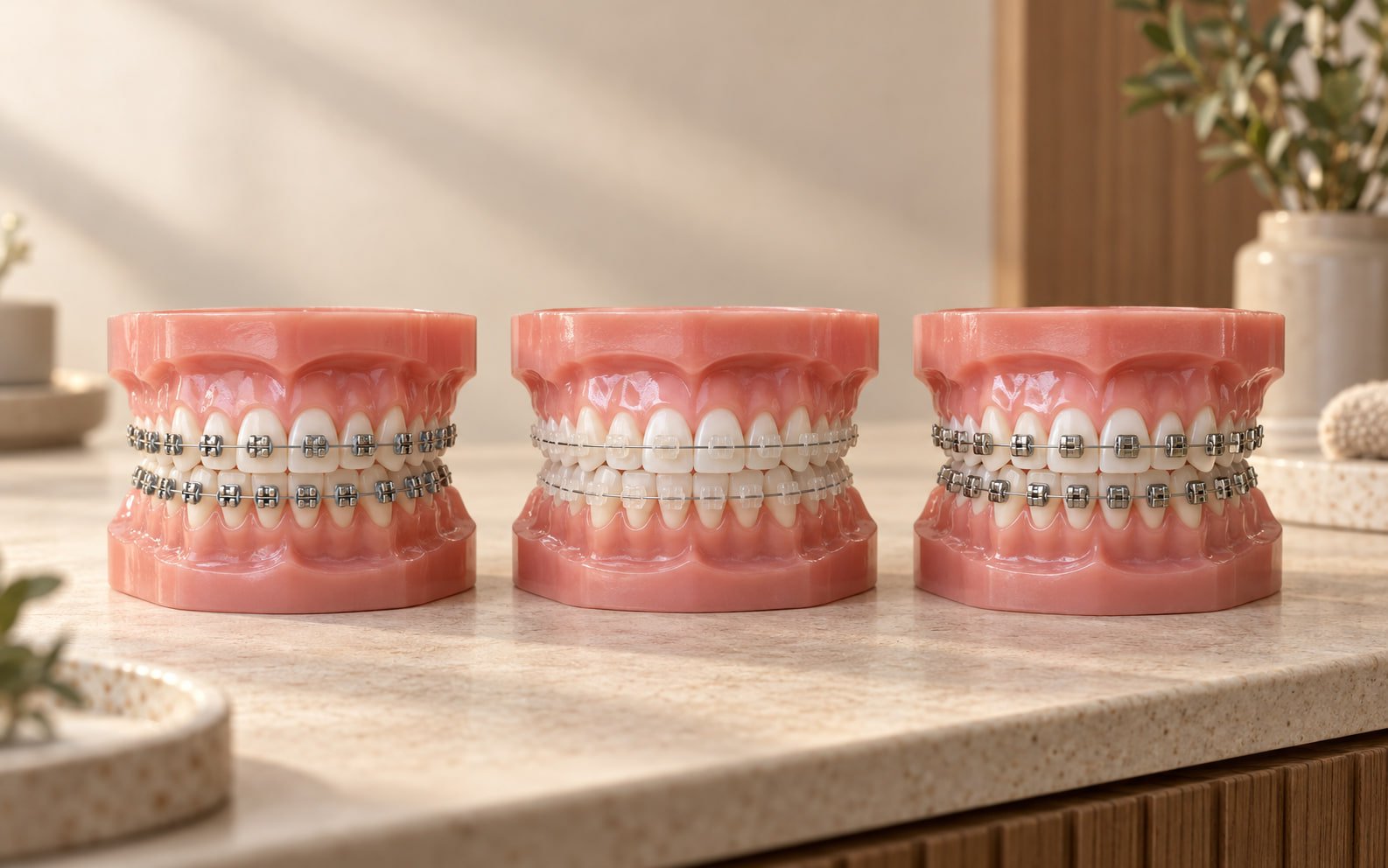
Fixed orthodontic braces can differ in bracket material and in how they retain the wire. Metal costs less, ceramic is less noticeable, and self-ligating brackets have a built-in door or clip. What does this mean for durability, pain, treatment time and follow-up costs? We compare benefits, limitations and prices so that before seeing an orthodontist you understand what an upgrade offers — and when it does not solve your problem.
 ortosmilesilesia.pl
Types of fixed orthodontic braces: material and mechanism
In orthodontics, “metal or ceramic?” and “conventional or self-ligating?” refer to two different appliance features. The first concerns bracket material and appearance; the second concerns how the archwire is held. The combinations include conventional metal, self-ligating metal, conventional aesthetic and self-ligating aesthetic brackets. Calling an appliance “modern” does not explain what you will actually receive.
Brackets are bonded to teeth and an archwire delivers planned forces. Conventional brackets use small elastic or wire ligatures; self-ligating brackets use a built-in door or clip. This does not mean treatment never involves elastics. Elastics between the upper and lower jaws serve a different purpose in bite correction and may still be necessary.
Every appliance is a tool for carrying out a treatment plan, not a ready-made solution for every bite problem. Tooth contacts, gum health, available space, planned movements and cooperation also matter. This comparison mainly covers braces on the outer surfaces of the teeth; lingual braces placed on the inside are a separate subject.
Fixed orthodontic braces: benefits and drawbacks
In short, metal offers durability and a lower initial cost; ceramic offers a less noticeable appearance; self-ligation changes how the wire is handled. None of these features alone guarantees a better result. In this table, self-ligating describes a construction that can also be used in aesthetic brackets.
Metal and ceramic — what do brackets look like?
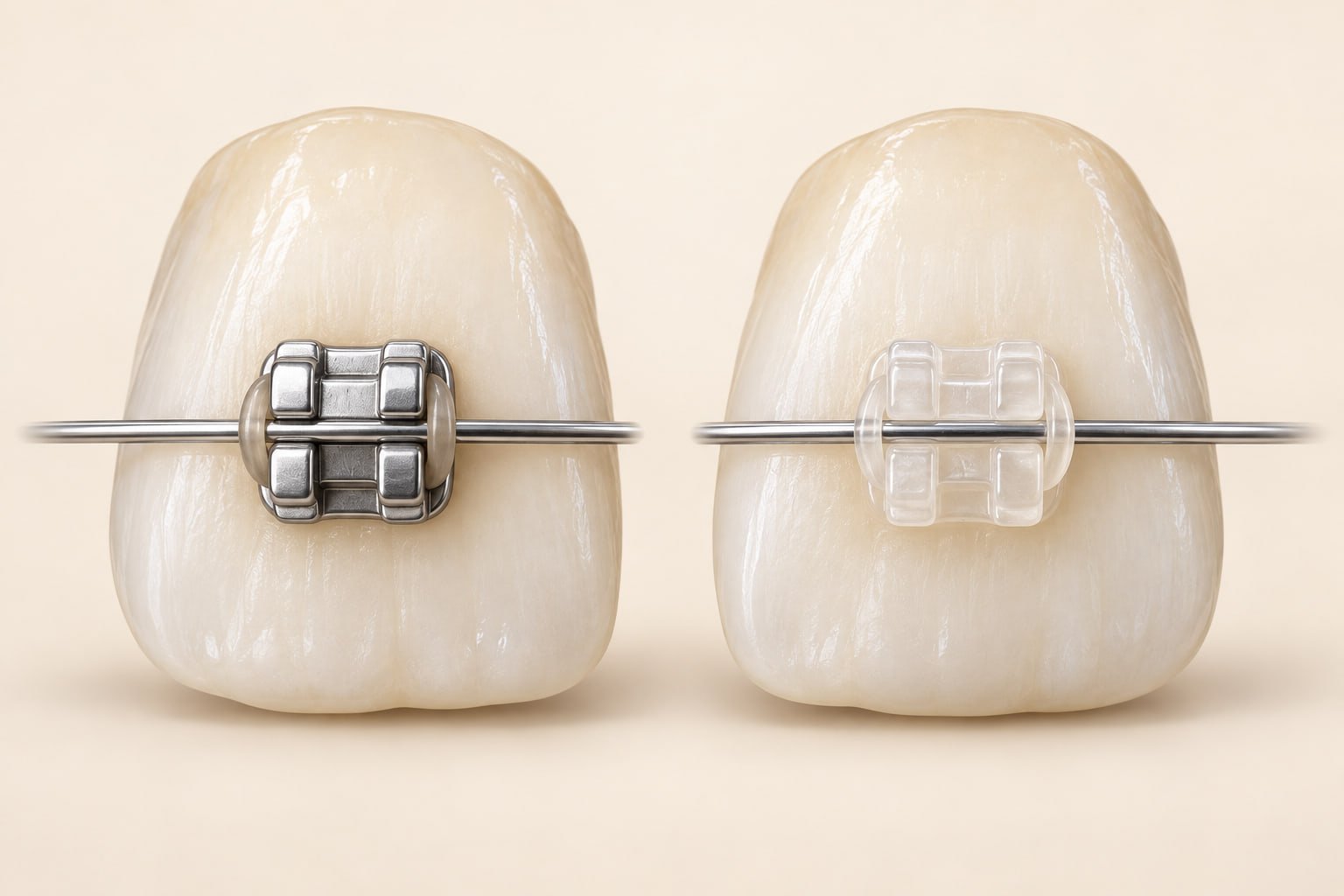
Metal stands out more against the enamel.
Ceramic blends with the tooth colour, but the bracket and wire remain visible.
Illustration, not a patient photograph. Bracket and ligature appearance and dimensions vary by system.
| Appliance | Main benefits | Limitations and trade-offs |
|---|---|---|
| Conventional metal | Robust brackets; lowest initial price in the options compared here; choice of ligature colours | Visible metal; careful cleaning around ligatures and under the wire |
| Conventional ceramic / aesthetic | Less contrast with teeth; fixed treatment without remembering to insert aligners | Extra cost for appearance; ceramic brittleness; light ties can stain; bite contacts must be checked |
| Self-ligating metal | Door retains the wire without routine elastic ligatures; may simplify wire changes | Still visible; higher price; no guarantee of shorter treatment or less pain |
| Self-ligating aesthetic | Less noticeable brackets combined with a built-in closure | Highest price in this comparison; material limitations and cleaning requirements remain |
Metal braces: when are they a sensible choice?
Conventional metal braces are not an inferior version of treatment. They can be a good choice when fixed treatment fits the diagnosis, visibility is acceptable and you want to budget for the whole process: diagnosis, follow-up and retention. It is reasonable to start the comparison here rather than assume that a more expensive bracket must work better.
Steel is durable, but a bracket can still detach when you bite something hard. Metal braces also need cleaning under the wire and around every bracket. Some teenagers enjoy coloured ties; others prefer silver or neutral colours. This is a preference, not a measure of treatment effectiveness.
Reasons to consider metal
- Lower fitting price in the compared price-list categories.
- Durable material suitable for many treatment plans.
- No extra charge solely for less visible brackets.
What you need to accept
- Metal components are visible when speaking and smiling.
- Rubbing and initial tooth tenderness are still possible.
- Suspected allergy requires a discussion of all components, not brackets alone.
Ceramic braces: when is the aesthetic upgrade worthwhile?
Ceramic may make sense if visible metal is a significant obstacle to starting treatment: during presentations, meetings or everyday conversations. This is not a suggestion that anyone should feel embarrassed by braces. It is about the comfort of the person who will wear them. When both materials are appropriate, appearance is a legitimate part of the decision.
Ceramic braces are not invisible. The wire, elastics and other components may still show. Light ligatures can stain between appointments even when the bracket keeps its colour. Ceramic is more brittle than metal, making food choices and care important. “Aesthetic” is also a wider category than “ceramic”; the exact material and construction should be confirmed when agreeing on the plan.
Lower brackets need particular attention in a deep bite if the upper teeth could bite onto them. Contact with hard ceramic can damage an opposing tooth. The orthodontist checks these contacts and considers another bracket placement, metal or appropriate additional measures. This is a situation where appearance must not come before safety.
Benefits of ceramic
- Less contrast between brackets and natural tooth colour.
- Less noticeable fixed treatment when aligners are not wanted or suitable.
- In selected plans, ceramic upper brackets can be combined with metal lower brackets.
Drawbacks and limitations
- Higher cost than conventional metal, primarily for appearance.
- More brittle material; the wire may remain visible and light ties may stain.
- Not every bite allows ceramic brackets in every area.
Self-ligating versus conventional braces: what does the extra cost buy?
A self-ligating bracket retains the wire with an integrated mechanism rather than a routinely fitted elastic tie. Opening and closing the doors may simplify some tasks for the orthodontist. For the patient, the main difference is construction, not automatically a shorter treatment. Ask what particular benefit the clinician expects in your plan.
Active and passive mechanisms differ in their contact with the wire. You do not need to choose one from a catalogue, and a trade name is not a diagnosis. Damon is an example of a system name, not a synonym for all self-ligating appliances; confirm whether a particular brand is available at the clinic. A brand alone cannot determine whether elastics, space creation or extractions are needed.
What holds the wire inside an orthodontic bracket?
Conventional bracket
- Orthodontic archwire
- Elastic ligature
A ligature wraps around the bracket wings and retains the wire in its slot. The diagram shows an elastic ring; a ligature can also be metal.
Self-ligating bracket
- Orthodontic archwire
- Built-in door / clip
A built-in door or clip retains the wire in the bracket. No separate ligature is needed to secure it.
Material and mechanism are two different features. Both metal and ceramic brackets can be conventional or self-ligating.
Simplified attachment diagram, not a drawing of a particular brand. Self-ligation does not rule out interarch elastics — these serve a different purpose.
Actual construction benefits
- An integrated door holds the wire without routine elastic ties on those brackets.
- Some wire-handling tasks may be more efficient during appointments.
- Metal and aesthetic versions let you consider mechanism and appearance separately.
Promises to avoid
- Always less pain, shorter overall treatment or fewer appointments.
- Treating every bite without extractions simply because of the bracket.
- Easy hygiene without thorough daily cleaning.
Ceramic and sapphire orthodontic brackets: mixed braces
Aesthetic appliance descriptions include ceramic, porcelain, crystal and sapphire. Sapphire brackets are a form of monocrystalline ceramic; other ceramic brackets may look milkier or tooth-coloured. Transparency alone does not mean a bracket will look less noticeable on your teeth. Tooth shade, lighting and the archwire also matter.
Do not pay extra solely for an appealing name. Ask to see the actual bracket and clarify what the offer includes. Mixed braces may combine aesthetic brackets in the visible area with metal elsewhere. This requires compatible components, a bite assessment and an individual quote; its price cannot be calculated simply by halving the charge for an arch.
Which orthodontic appliance fits your situation?
These scenarios are a discussion aid, not an online prescription. The orthodontist first identifies options that are safe and able to carry out the required tooth movements. Within that group you can compare appearance, cost and convenience. If a particular option is unsuitable, you should understand the reason rather than simply be told another one is “best”.
| Your priority or situation | What to discuss | What to check |
|---|---|---|
| Budget and durability | Conventional metal braces | Full treatment costs, not only fitting |
| Less noticeable brackets | Ceramic or another aesthetic option | Bite contacts, exact material, wire visibility and surcharge |
| A mechanism without elastic ligatures | Self-ligating brackets | Reason in the plan, follow-up costs and realistic expectations |
| Deep bite; teeth contact lower brackets | Material and placement selected after examination | Tooth contacts; do not choose ceramic without assessment |
| Strong concern about visible braces | A mixed option or assessment for aligners | Suitability for the bite and your ability to cooperate |
| Poor hygiene or bleeding gums | Hygiene improvement and a health assessment first | An expensive bracket cannot replace oral preparation |
How much do fixed braces cost? One arch and two arches
These fitting prices come from the OrtoSmile price list checked on 9 October 2026. One arch means the upper or lower teeth. The two-arch column is simply twice the one-arch price, assuming the same option above and below. It is not the price of complete treatment or an individual quotation. All amounts are in Polish złoty.
We keep the price-list label “aesthetic” because it does not specify the exact bracket material. Confirm whether the discussed appliance is ceramic, another aesthetic material or a mixed configuration. Iconix also appears in the list at 2700 zł per arch: this is a named solution, not a separate self-ligating mechanism.
| OrtoSmile price-list option | Fitting: 1 arch | Fitting: 2 arches (2 ×) |
|---|---|---|
| Conventional metal | 2700 PLN | 5400 PLN |
| Conventional aesthetic | 3000 PLN | 6000 PLN |
| Self-ligating | 2900 PLN | 5800 PLN |
| Self-ligating aesthetic | 3500 PLN | 7000 PLN |
Compared with conventional metal, conventional aesthetic costs 300 zł more per arch or 600 zł more for two. Self-ligating costs 200 zł more per arch or 400 zł for two; self-ligating aesthetic costs 800 zł more per arch or 1600 zł for two. Conventional metal is the cheapest of these fitting options and aesthetic self-ligating the most expensive.
Other stages must be included according to the plan. The list shows a consultation at 250 zł, a diagnostic package at 320 zł and an individual treatment plan at 250 zł. A conventional-brace follow-up is 250 zł and a self-ligating follow-up 300 zł. Do not assume that fewer appointments will offset a more expensive visit: scheduling depends on the individual treatment.
Later costs include appliance removal at 500 zł per arch and prescribed retention: a fixed retainer at 500 zł or a removable retainer at 500 zł; retention follow-up is 200 zł. Rebonding a detached bracket is listed at 50 zł. Not every item applies in the same way to every person. Ask for a breakdown of stages, expected visits, possible repairs and exactly what each charge includes.
Orthodontic treatment time, pain and appointment frequency
Brackets differ in construction and handling, but paying more does not by itself make teeth move faster. Duration depends on the diagnosis, planned movements, tissue response, age and periodontal health, along with attendance and following instructions. Many fixed treatments take about 18–24 months, but a simpler or more complex plan can differ considerably. This is an orientation range, not a promise.
Reviews comparing conventional and self-ligating brackets do not justify promising everyone a shorter complete treatment, fewer visits or less pain. Faster wire handling at one appointment is not the same as a shorter course. Ceramic also works within an individual plan: less visible brackets do not automatically mean weaker or slower treatment.
Tenderness after fitting or changing the wire can occur with any system. Rubbing also depends on component shape and individual adaptation. If pain increases, does not settle as discussed, or comes with swelling or damage, contact the clinic. Do not choose a system on a promise of completely pain-free treatment.
Hygiene, staining, food and sport with fixed braces
Every bracket creates extra plaque-retaining areas. Thorough brushing, cleaning under the wire and between teeth, and tailored instruction are necessary. A 2024 meta-analysis suggests possible benefits of self-ligating brackets in some plaque and bleeding measures; earlier reviews did not find a clear advantage. These findings do not justify calling an appliance self-cleaning or relaxing hygiene.
Coffee, tea, tobacco and strongly coloured spices may affect light ties or deposits around brackets. The response is cleaning and ligature replacement at appointments, not home whitening while braces are attached. White patches around brackets can reflect enamel demineralisation rather than a purely cosmetic stain and need assessment.
Cut hard food into small pieces instead of biting directly with bracketed teeth; avoid very sticky products according to instructions. Report a detached component and never use household glue. For contact sports, discuss a mouthguard suitable for braces. Sport is not by itself a reason to avoid treatment, but teeth need protection whatever the bracket material.
What should you ask your orthodontist before choosing fixed braces?
An informed decision is not a bracket order from a catalogue. It means understanding the problem, goal, alternatives and costs. Before agreeing to a plan, ask which options offer comparable ways to reach your goal and why the clinician advises against others. If the reason for an extra charge is unclear, ask for a direct explanation.
- 01
Need and consultation
Explain your priorities: bite, appearance, everyday comfort and budget. Mention allergies, gum disease and earlier treatment.
- 02
Diagnosis
Examination and appropriate records establish the problem and safe limits for moving teeth.
- 03
Choice of method
Ask about bracket choice, number of arches, elastics, additional components and alternatives.
- 04
Informed decision
Agree on cost stages, follow-up schedule, what to do if something breaks and retention afterwards.
Patient questions about types of orthodontic braces
Which orthodontic braces are better: metal or ceramic?
If both fit the plan, metal offers durability and a lower price, while ceramic is less noticeable. This does not make one material superior in every case. Lower brackets in a deep bite need particular checking for contact with opposing teeth. If appearance is not a priority, there is no reason to pay more just because brackets look more premium. If it matters, ask to see the actual bracket and whether the extra cost matches a meaningful difference. The decision should account for the complete plan and budget.
How much do braces on the upper and lower teeth cost?
Fitting two conventional metal arches is 5400 zł in the checked list: twice 2700 zł. Two conventional aesthetic arches are 6000 zł, self-ligating 5800 zł and aesthetic self-ligating 7000 zł. These figures cover fitting the same option on both arches, not the complete treatment. Diagnosis, follow-up, possible repairs, removal and retention are separate stages. A mixed configuration may have a different quote. Confirm current prices and the plan’s scope with the clinic.
Do ceramic braces turn yellow, and can I drink coffee?
Colour changes often affect light ties and deposits rather than the ceramic bracket itself. Coffee, tea and strongly coloured spices can make such stains more visible. This does not automatically mean avoiding coffee for the entire treatment, but careful hygiene and expectations about tie appearance matter. Ties are replaced at appointments according to treatment needs. Do not use aggressive home products or whiten teeth yourself with brackets attached. Report enamel patches or bleeding gums instead of assuming they are only a colour issue.
Are ceramic or sapphire brackets less noticeable?
Sapphire brackets are a type of ceramic, and marketing names are not always used consistently. Transparent does not always mean less visible: tooth shade, bracket shape and the wire matter too. A milky or tooth-coloured option may blend better with some teeth than a highly transparent one. Look at the actual model instead of relying only on promotional photographs. Ask about material and cost. First confirm that the option suits your bite contacts.
Do self-ligating braces work faster and need fewer appointments?
The bracket door alone cannot guarantee this. Reviews do not show a consistent advantage in overall duration or number of visits. Some chairside tasks may be quicker, but that is a different benefit. Your orthodontist sets intervals according to treatment stage, wire and tissue response. Do not extend them yourself because your braces are self-ligating. Ask for an individual estimate and what could change it.
Are self-ligating braces less painful than conventional braces?
There is no basis for promising painless treatment or a reliable advantage for every self-ligating system. Tenderness results from tissue response to tooth movement and can occur with both constructions. Bracket rubbing also depends on shape and cheek adaptation. Follow your instructions about food, cleaning and orthodontic wax. Severe or increasing pain needs contact with the clinic. A justified treatment plan is more important than a claim that you will feel nothing.
Do self-ligating braces mean treatment without extractions?
No: the wire closure does not decide whether teeth need removing. Available space, tooth position, profile, jaw relationships and healthy periodontal limits are among the relevant factors. Not everyone needs extractions, but a system name cannot rule them out. The orthodontist should explain the available ways to create space and their limitations. An “always without extractions” promise before diagnosis is not a sound basis for choosing. Ask about your individual case.
Can I have ceramic braces above and metal braces below?
Some plans allow this, combining a less noticeable visible arch with metal on the other. It is not the right pattern for everyone. Bite contacts, compatible components and required movements must be checked. Other material combinations within an arch may also be possible. Prices are quoted for the actual configuration, not by arbitrarily averaging listed fees. Ask how it would look in your smile and what later treatment stages may require.
Can orthodontic braces be fitted on just one arch?
Sometimes, but only when the bite plan allows it. Upper and lower teeth work together, so aligning one arch may change their contacts. A crooked tooth visible only above does not establish that only the upper arch needs treatment. A per-arch price is a price-list unit, not advice to limit treatment without examination. Ask what would change in the bite. If both arches are needed, the clinician should explain why.
Are ceramic braces safe if I have a nickel allergy?
A ceramic body does not mean the entire appliance is metal-free or nickel-free. The wire, bracket slot, clip, bands and other components may contain metal. Report a confirmed or suspected allergy before treatment begins. The orthodontist will assess available materials and whether further assessment is needed. Do not select an appliance just by its colour or the label aesthetic. Safety concerns the full component set and your history, not a single bracket.
Are ceramic brackets more likely to break, and what if one detaches?
Ceramic is more brittle than metal, although actual risk also depends on the model, bite and eating habits. Any bracket can detach. Do not glue it yourself or force the wire into another shape. Contact the clinic, explaining the component and any rubbing, so the team can advise on timing and temporary help. Breathing difficulty after suspected inhalation of a component needs urgent medical attention. A repair does not mean the whole plan has failed, but do not postpone it without advice.
Which fixed braces suit a teenager, and which suit an adult?
Age does not automatically determine material: a teenager may have aesthetic braces and an adult conventional metal. The bite problem, dental and periodontal health and daily cleaning are more important. Some younger patients enjoy coloured ties, while others value discretion. Adult plans may need to account for crowns, implants or periodontal care. Include the preferences of the person wearing the braces, not just those around them. Compare the safe options by cost and appearance afterwards.
Do more expensive braces give a better result or replace retainers?
A system price does not guarantee better alignment or long-term stability. The extra charge may relate to material, appearance or the bracket mechanism. Results depend on diagnosis, planning, treatment management and cooperation. Every system discussed here needs an individual retention plan afterwards. Teeth can change position without it even after the most expensive option. Compare the entire process and its continuation, not just fitting prices.
- AAO — braces: construction and available types
- AAO — ceramic braces: appearance, durability and eligibility
- British Orthodontic Society — conventional and ceramic fixed braces
- Systematic review — pain, visits and treatment time (2013)
- Systematic review — efficiency of self-ligating brackets (2010)
- Systematic review — clinical effects of self-ligating systems (2010)
- Systematic review and meta-analysis — oral hygiene and discomfort (2016)
- Systematic review and meta-analysis — periodontal health (2024)
- BOS — nickel allergy and orthodontic materials